

When I describe my favourite kind of lesson, I get a look. Usually from people who don’t teach Design and Technology, sometimes from those who do. You know the one. Shock. Horror. The right eye twitch. Like I’ve just described their worst nightmare.
They strive for calm and compliance and my classroom is far from that. My classes aren’t quiet. They aren’t ordered. They don’t conform to the kind of structure that keeps clipboard types happy and I’m unapologetic about that.
They’re beautifully chaotic. And wildly productive. My happy place.
Picture this: rainy Thursday afternoon. Late in the day, deep into the term. Twenty-four fourteen-year-olds who should, by all accounts, be entirely over it. Instead, the room is humming. Machines running. Power tools whirring. Materials of every kind being measured, cut, glued, nailed, clamped. Messy sketches and detailed drawings scattered across workbenches. Some being revised, some abandoned entirely, some transcended. Not one student is at the same stage. Not one outcome looks the same. They’re following a process, and that process is leading each of them somewhere different, somewhere genuinely their own.
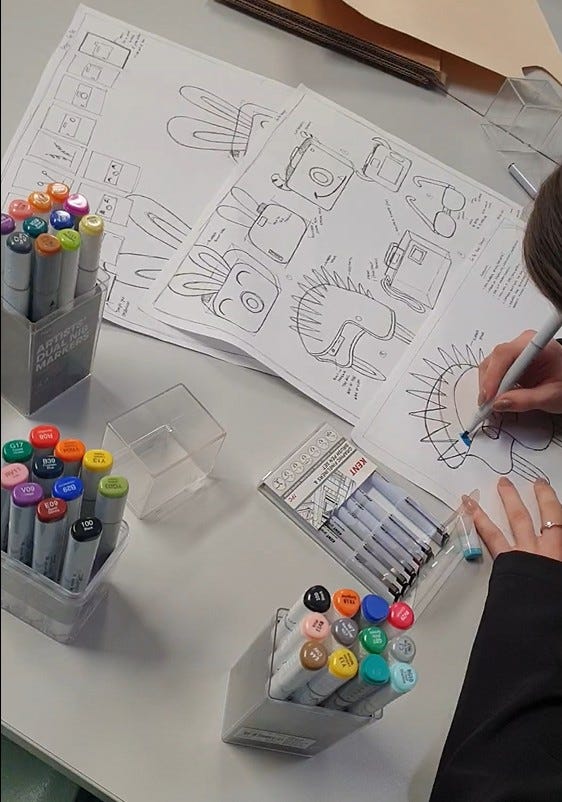
Some of them are working at a level, or in a direction, that is beyond my skill set.
And I love that. In fact, it’s what I strive for.
They stopped coming to me with every problem somewhere around week three. Probably because I always answer with a question not a solution. Now they nut it out. Quietly, determinedly. Or they turn to each other for feedback, for inspiration, for a second set of eyes. Sometimes they get it wrong. It frustrates them. But it doesn’t stop them. They’re invested. They trust the process. And because they trust it, so do I. Plus I’m there with my safety net of encouragement and guidance to lift them up when they need it.
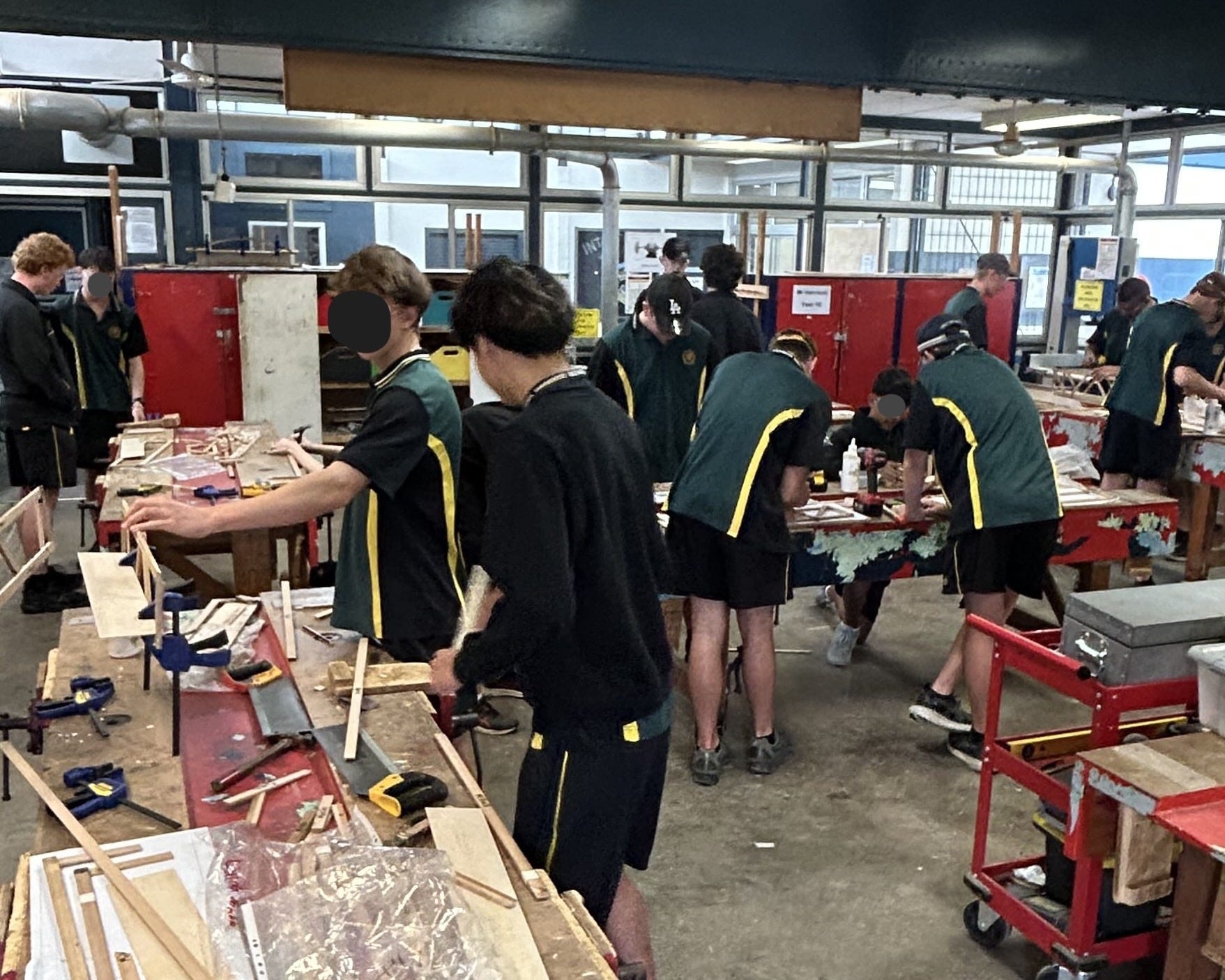
This is Design and Technology at its best. And, really, this is learning at its best.
Don’t get me wrong. This didn’t happen by accident, and I’m certainly not sitting back with my feet up. This beautiful, productive chaos is the result of deliberate groundwork: understanding this cohort’s capabilities and interests and working through the problem myself before presenting it so I know where they might stumble and where they might surprise me.
The unit is carefully planned, but not rigid. It’s front-loaded with skills and knowledge, and my role shifts as the unit progresses, from designer of the experience to guide, to collaborator, to occasional guardrail. By this point in the term, they don’t need me at the front of the room, and that’s not incidental. That’s the goal.
It’s still not perfect. Not everyone is producing A-grade work, and some days are harder than others. These aren’t all easy students, and this isn’t an easy room.
But that’s entirely the point.
For as long as I can remember (and I’ve only been in education just over a decade) the words student agency, empowering learners and project-based learning have floated around staffrooms and whole-staff meetings like exciting new discoveries. Every time I hear them spoken with fresh enthusiasm, I smile to myself and think we’re already doing that.
That’s just Design.
And honestly? I get it. Survey a cross-section of educators and Design is probably the most misunderstood subject in the room, even among those of us who love teaching it. Early in my time as an ITD Head of Department, I had conversations with genuinely passionate staff who believed they were delivering great Design outcomes by having students laser engrave a downloaded image onto a piece of wood. Beautiful execution. Identical results. No design thinking in sight. They weren’t wrong to be proud of what their students made; they just hadn’t yet seen the bigger picture of what Design could be.
The moment I treasure most is this one: watching a colleague reach for a pencil and paper mid-conversation to sketch out an idea they’re trying to explain to me. I stop them gently and say, that’s Design thinking. You’re a designer.
Or when they’re mid-lesson, something goes sideways, and they improvise creatively to keep the learning moving safely forward. That’s Design. The realisation, when it lands, is something special. You can see it happen in real time.
Some of the most rewarding conversions I’ve witnessed have been the old-school, practical, hands-on teachers, the ones who’d never in a million years call themselves designers suddenly recognising that everything they do, everything they value, sits at the very heart of 21st century learning. That their subject isn’t a relic. It’s a rocket ship. Construction is cognitive. Innovation is academic. Adaptability and resilience aren’t soft skills; they’re the whole game. The pride that follows that realisation is something I will never tire of seeing.
I recently encountered a presentation framed around a single provocation: Design is a verb, not a noun. And that’s it. That’s the whole thesis in one clean sentence. Design is not a product or a discipline or a department. It’s a construct, a tool, an experience, a method. It looks different for every learner and it’s incredibly liberating for educators willing to let go of the reins; to pose a problem and trust students to find their own way through it.
That’s not a noble notion. That’s not some future of education we’re aspiring toward. It’s here and it’s now. And Design and Technology is more than ready to deliver it.
At the nitty gritty centre of it all, we are all designers. It’s intrinsic. It’s ingrained. It always has been. Sometimes we just need a nudge to realise it and then space to let it grow.
Just imagine where it will take the students sitting in our rooms right now.
The possibilities are endless.
And that’s why I love Design and Technology. Not for what students make, but for who they become in the process.
About the Author: Carol Flikweert
Having always resisted straight lines and conformity, Carol didn't arrive here with a destination in mind but rather through experiencing different ways of looking at the same problem. From designer to classroom teacher, head of department to curriculum contributor, the common thread has always been curiosity and a why-not attitude. She navigates her career the same way she teaches, by figuring it out as she goes. Carol is currently an acting Deputy Principal in Queensland, where she still considers the ITD classroom her favourite place to think.
This brought to mind my experiences in the best montessori classrooms. I would love to know your opinions about explicit teaching. As you described, your students need significant training to work this way, and I wonder whether or not that training could be considered "explicit teaching". Certainly in the Montessori space, "lessons" are taught very explicitly, followed by relatively unstructured practice and experimentation. I teach high school Science and Maths, and while my lessons are structured within an explicit teaching framework, the pinnacle of each unit is when students apply their new skills and knowledge to designing an investigation. Now I want to invade my school's D and T lab and discover what they do, and what I can learn from them! I would also love for someone to observe my practise and point out, "that's design thinking"!